Clients are asking about both, and the two are often lumped together. Gua Sha vs IASTM is one of the most common questions practitioners have when deciding which hands-on tool technique to add to their practice. Both use a smooth-edged tool on the skin to influence soft tissue, but they come from different traditions and are used for different reasons.
What Is Gua Sha?
Gua Sha is a traditional East Asian technique. The practitioner applies oil, then strokes the skin with a smooth tool, often in long, repeated strokes. It can leave temporary redness or small red marks called “sha,” which is part of the traditional approach. Gua Sha is commonly used for muscle tension, circulation and general wellness work.
What Is IASTM?
Instrument-Assisted Soft Tissue Mobilization (IASTM) is a modern, clinically oriented method. Practitioners use specially shaped tools, often stainless steel, to assess and treat soft tissue restrictions. It is popular in rehabilitation and sports settings, where the goal is usually to improve mobility and reduce pain around a specific area.
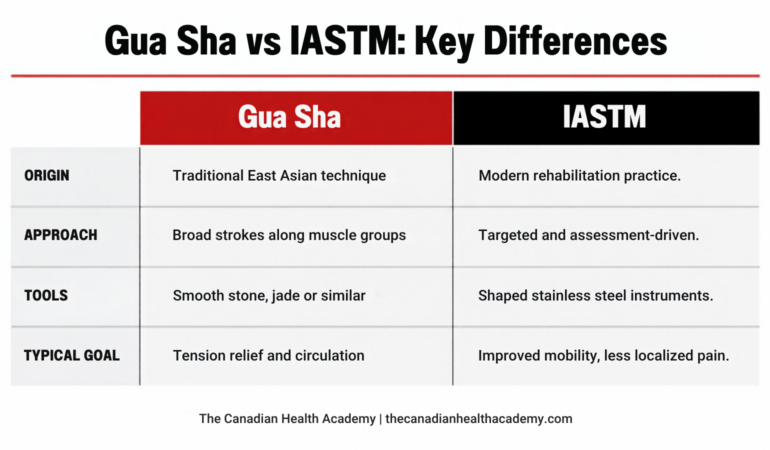
Gua Sha vs IASTM: The Key Differences
| Gua Sha | IASTM | |
|---|---|---|
| Origin | Traditional East Asian technique | Modern rehabilitation practice |
| Approach | Broad strokes along muscle groups | Targeted and assessment-driven |
| Tools | Smooth stone, jade or similar materials | Shaped stainless steel instruments |
| Typical goal | Tension relief and circulation | Improved mobility and less localized pain |
Research on both techniques is still developing and results are mixed, so practitioners should be honest with clients about expected outcomes.
Which Should You Learn: Gua Sha or IASTM?
It depends on your clientele. If you work in wellness or relaxation-focused massage, Gua Sha training is a natural fit. If you treat sports injuries or movement restrictions, IASTM certification may serve you better. Many practitioners find the two complement each other, and learning the foundations of both means you can choose the right tool for each client.
A Note on Scope of Practice
Before adding either technique, check with your regulatory college (for example, the College of Massage Therapists of Ontario for Registered Massage Therapists) and your insurer to confirm it falls within your scope of practice.
Train With The Canadian Health Academy
Our Gua Sha & IASTM course teaches both techniques in a hands-on setting for massage therapists, healthcare professionals and wellness practitioners. Explore all of our CEU-accredited training on our courses page.