“Buccal massage” has gone from a niche technique to a social media trend, and clients now arrive asking for it by name, sometimes for a sore jaw as much as for a facial. At the same time, manual therapy for temporomandibular joint (TMJ) dysfunction is a long-established part of rehabilitation and manual therapy practice. Both can involve working inside the mouth, which is why the two are often confused. For massage therapists, physiotherapists, and other healthcare practitioners, the distinction matters for assessment, consent, evidence and scope of practice. This article explains how they differ, what the research says, and what to consider before adding either to your services.
What Is Buccal Massage?
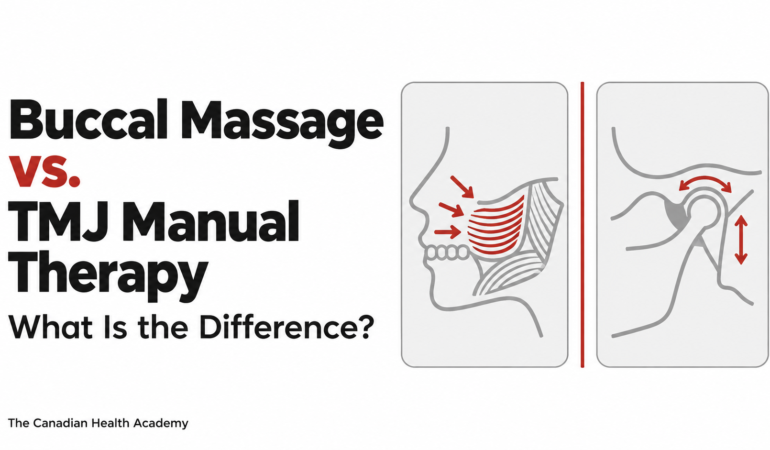
Buccal massage, also called intraoral massage, takes its name from the Latin word for cheek. In a typical session, the practitioner places gloved fingers inside the mouth, in the space between the teeth and the inside of the cheek, and works with a thumb on the outside to stretch and massage the cheek tissues [1]. It is most often offered as a facial or facial-wellness service, with claims about contouring, puffiness and facial tension.
The evidence base is thin. A university health-science commentary noted that there are no rigorous controlled studies showing that buccal massage produces a lasting change in facial contour, and described claims of a lasting lift as anecdotal [1]. The same source acknowledged that facial massage may give some relief to people with jaw clenching or bruxism when it relaxes tense muscle [1].
What Is Manual Therapy for TMJ Dysfunction?
Temporomandibular disorders (TMD) are considered the main musculoskeletal cause of orofacial pain. They are a group of conditions, and can involve the joint itself, a displaced disc, hypermobility or the muscles of mastication [2]. Manual therapy for TMD is a clinical intervention aimed at a defined problem, such as jaw pain, restricted mouth opening, clicking or muscle tension, identified through assessment.
Techniques vary by practitioner and profession. Trial protocols describe, for example, intraoral release of the masseter, temporalis, and lateral and medial pterygoid muscles using inhibition, along with joint techniques that distract and articulate the mandible [6]. Other approaches treat the cervical region as well, because neck and jaw function are linked [4]. Many programs combine hands-on work with home exercise [2].
Key Differences at a Glance
| Feature | Buccal massage | Manual therapy for TMJ dysfunction |
|---|---|---|
| Main purpose | Facial wellness, relaxation, appearance-related goals; sometimes jaw tension | Reducing pain and improving jaw function in a client with TMD symptoms |
| How it starts | Often a service request | Health history, symptom review and a jaw and neck assessment |
| Techniques | Intraoral stretching and kneading of the cheek with outside counter-pressure [1] | Intraoral and extraoral soft tissue work, joint mobilization, often cervical work and exercise [2][4][6] |
| Structures involved | Cheek tissues and buccinator region; deeper muscles are sometimes described | Masticatory muscles, TMJ, and often the neck |
| Evidence | No rigorous controlled studies of buccal massage itself [1] | Randomized trials and systematic reviews, with mixed quality [2][3][4] |
| Outcomes measured | Rarely measured | Pain, maximum mouth opening, function [2][3] |
| Practitioner skill needed | Intraoral technique, infection control, consent | All of that, plus orofacial assessment, clinical reasoning and referral judgment |
Where the Two Overlap
The overlap is real. Both can involve gloved work inside the mouth, and both can touch muscles such as the masseter. A relaxation-oriented buccal massage may ease a clenched jaw, and a TMD treatment may include techniques that look very similar to buccal work. What differs is the clinical framework. In TMD care, the intraoral technique is one tool selected because of an assessment finding, tracked against outcomes such as pain and mouth opening, and paired with advice and exercise. In a standard buccal facial, the technique is the service.
That distinction affects how you describe your work to clients. A practitioner who offers buccal massage for general facial tension should avoid implying that it treats a TMJ condition. A client with persistent jaw pain, locking or clicking deserves an assessment, and possibly a referral, not only a facial.
What Does the Research Say About TMJ Manual Therapy?
Medium-term effects. A systematic review and meta-analysis of six randomized trials, each with at least three months of follow-up, found significant improvement in pain and mouth opening compared with baseline after manual therapy. The effect appeared to fade over time, but combining manual therapy with therapeutic exercise helped maintain the benefit in the longer term [2].
Short-term effects across professions. A 2026 systematic review of 18 randomized trials on manual therapy for TMD, including treatment by different healthcare professionals, concluded that manual therapy may be associated with short-term improvements. The authors framed the question of which techniques and professional approaches work best as still unclear [3].
The cervical spine. A meta-analysis found that cervical manual therapy reduced pain intensity more than placebo manual therapy or minimal intervention in people with TMD, with moderate evidence. Combined cervico-craniomandibular treatment gave larger short-term reductions in pain and improvements in pain-free mouth opening than cervical treatment alone, but the evidence was low [4].
Intraoral massage specifically. A small randomized, placebo-controlled trial of 40 women with muscle-related TMD compared intraoral, extraoral and combined massage. The authors reported that combined and intraoral massage improved signs and symptoms [5]. This is a small, early study reported in a conference abstract, so it should be read as preliminary.
Why the evidence is limited
Across the TMD literature, trials are small, techniques differ, and the quality is variable [2][3]. Neither strong claims nor outright dismissal are supported. For buccal massage as a stand-alone cosmetic treatment, the situation is more basic: there is little research to review at all [1].
Safety, Consent and Scope in Ontario
- Infection control. Because the practitioner’s fingers are inside the client’s mouth, excellent hand hygiene and infection prevention and control measures, including gloves, are essential [1]. Safety data for buccal massage itself are lacking [1].
- Informed consent. The College of Massage Therapists of Ontario’s Standards of Practice, in effect since January 1, 2022, cover informed consent, consent for treatment of sensitive areas, an evidence-informed approach, and staying within the massage therapy scope of practice [7]. Intraoral work calls for especially clear explanation and consent.
- Know when to refer. Good practice is to defer or refer when a client presents with recent facial or jaw trauma, a jaw that is locked or cannot open, signs of infection or dental pain, unexplained swelling, or neurological symptoms. Apply your own profession’s guidance here.
- Check your scope and coverage. Confirm with your regulatory college and professional liability insurer that intraoral techniques are within your scope and covered before offering them.
Which Should You Offer?
The answer depends on your profession and your clients:
- If your clients mainly want facial relaxation: buccal massage may fit a wellness-oriented service, as long as you are transparent about the limited evidence, avoid contouring or treatment claims, and meet infection-control and consent standards.
- If clients present with jaw pain, clicking or limited opening: a TMD-focused approach built on assessment, outcome tracking, cervical screening and home exercise is better supported by research [2][4].
- If you want to do both: keep the two services clearly separate in how you book, document and describe them.
Building Your Skills with Healthcare Continuing Education in Ontario
Jaw and facial work builds on strong head, neck and soft tissue skills. If you are looking for healthcare continuing education in Ontario to support this kind of practice, The Canadian Health Academy offers hands-on courses in Mississauga that complement it:
- Craniosacral therapy for practitioners searching for craniosacral therapy certification in Ontario, a craniosacral therapy course in Ontario or craniosacral therapy training in Mississauga.
- Indie head massage, including Indie-head massage certification and training in Mississauga.
- Manual Lymphatic Drainage, with an MLD certification and course in Ontario, and Manual Lymphatic Drainage in Brampton for lymphatic drainage training in Brampton.
- Gua Sha and IASTM, for Gua Sha certification and IASTM courses in Ontario and Mississauga.
- Cupping therapy and K-Taping for cupping and K-Taping certification, courses and training in Ontario, Mississauga and Brampton.
- Hot stone therapy, hot bamboo massage and Swedish and relaxation massage, with certification, courses and training in Ontario and Mississauga.
As a health academy in Ontario, we provide healthcare training and healthcare therapy training for practitioners who want to expand their skills. Browse every program on our courses page, see our Continuing Education Brampton page for healthcare continuing education in Brampton, or visit the Registration page. Looking for healthcare certification courses and continuing education for healthcare professionals in Ontario? Contact us and we will help you find the right fit.
Frequently Asked Questions
Is buccal massage the same as TMJ massage?
No. Both can involve intraoral work, but buccal massage is usually offered as a facial service, while TMJ manual therapy is a treatment for a client with jaw symptoms, based on assessment and outcome tracking [1][2].
Does buccal massage help TMJ pain?
Facial massage may relieve some tension in people who clench or grind, but there is no rigorous research on buccal massage itself for TMJ conditions [1]. Manual therapy aimed at TMD has a larger research base, though of mixed quality [2][3].
Is intraoral massage safe?
Safety data for buccal massage are lacking, and infection control is essential because fingers are inside the mouth [1]. Screening, informed consent and appropriate referral are key.
Can Registered Massage Therapists in Ontario do intraoral work?
This depends on your scope of practice, training and your college’s standards. Confirm with the College of Massage Therapists of Ontario and your insurer before offering it [7].
Conclusion
Buccal massage and manual therapy for TMJ dysfunction share a technique but not a purpose. Buccal massage is typically a facial wellness service with little supporting research. TMJ manual therapy is a clinical intervention built on assessment, outcome measures, and, ideally, exercise, with a research base that is promising but mixed. For practitioners, the value lies in knowing which you are offering, describing it honestly, screening carefully and staying within scope.
This article is for educational purposes for healthcare and wellness professionals and does not replace individual clinical assessment. Check your regulatory college and insurer regarding scope of practice.
References
- University of Technology Sydney. Could buccal massage make you look older, not younger? UTS Newsroom, 16 February 2023. uts.edu.au
- Herrera-Valencia A, Ruiz-Muñoz M, Martín-Martín J, Cuesta-Vargas A, González-Sánchez M. Efficacy of manual therapy in temporomandibular joint disorders and its medium- and long-term effects on pain and maximum mouth opening: a systematic review and meta-analysis. Journal of Clinical Medicine. 2020;9(11):3404. doi:10.3390/jcm9113404
- Efficacy of manual therapy by different healthcare professionals on pain and function in temporomandibular disorders: a systematic review of randomized controlled trials. 2026. doi:10.1080/10669817.2026.2629282
- Effect of manual therapy and therapeutic exercise applied to the cervical region on pain and pressure pain sensitivity in patients with temporomandibular disorders: a systematic review and meta-analysis. Pain Medicine. 2020;21(10):2373-2384. doi:10.1093/pm/pnaa021
- Gama MCS, Rizatti-Barbosa CM, Alves MC, Bérzin F. Techniques of massage therapy in myogenous temporomandibular disorder: a randomized placebo-controlled trial. Conference poster, International Society of Biomechanics, 2013. isbweb.org
- The effect of intra-oral osteopathic technique on pain, maximum mouth opening, and disability in patients with chronic temporomandibular joint disorder. Australian New Zealand Clinical Trials Registry. anzctr.org.au
- Registered Massage Therapists’ Association of Ontario. New CMTO Standards of Practice (effective January 1, 2022). rmtao.com